
Rebranding the Alien (2/2)
The Original Nomenclature

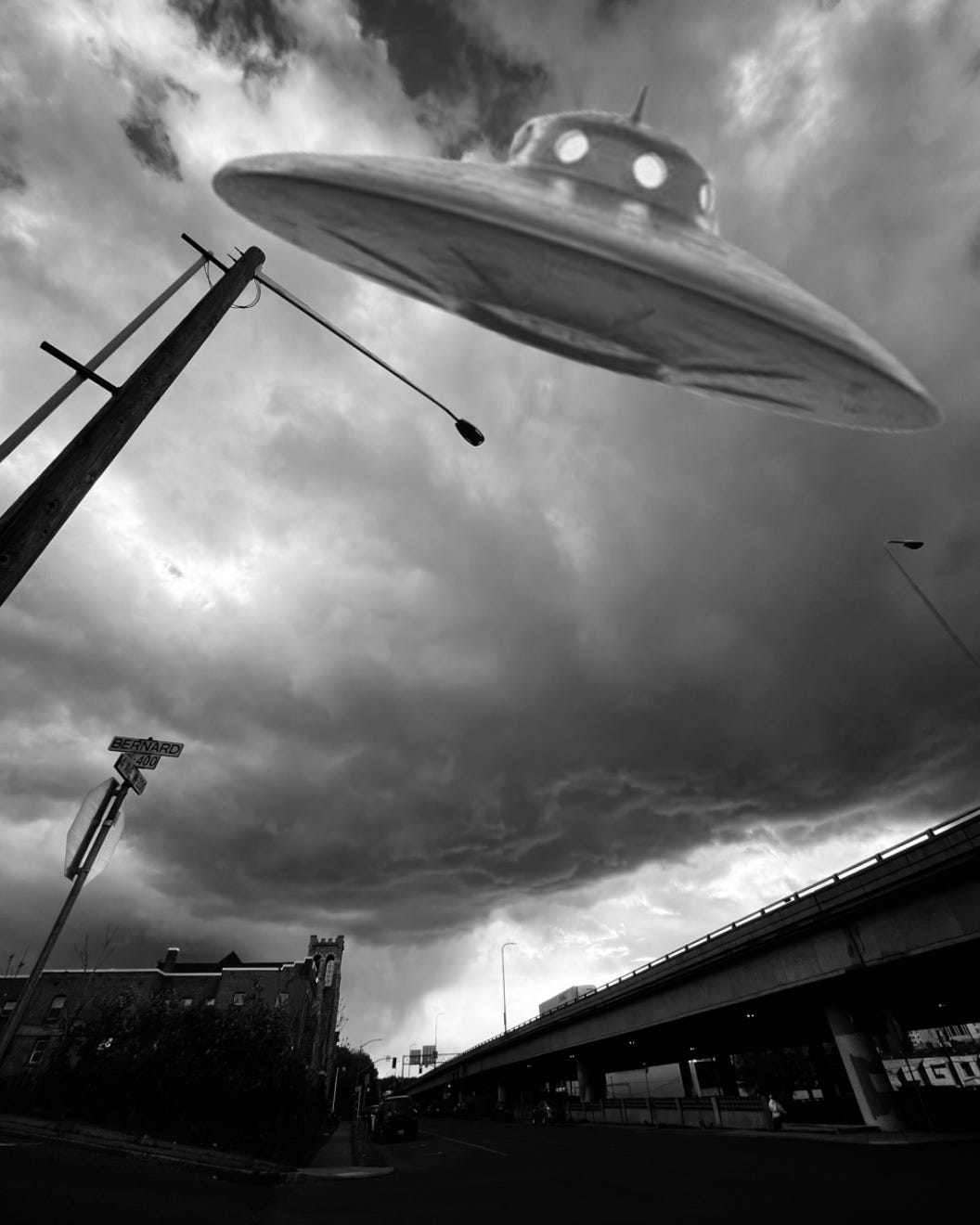
This is Part Two of a five-part series, examining how UFO gave way to UAP.
Read Part One here.
The irony of the UFO is that it began its life a the serious nomenclature option.
A sober replacement for the flying saucers and discs splashed across postwar newspapers as mass sightings erupted over the continental United States.
Allied victory over the Axis in World War Two had only just happened.
The working assumption was that Soviet technology lagged the West.
And yet now U.S. airspace was being violated by superior craft of unknown origin.
The government’s need to get control of the narrative was paramount.
Especially because they didn’t know where it was going.
Got that? They had to control the story while recognizing that at any moment the narrative could get pre-empted.
As in -- exogenous intervention.
Maybe even landing on the White House lawn.
Imagine the dilemma for those in charge of U.S. security.
And if they turned out to be Soviet --
That was even worse.
So the Pentagon reached for a label that was just clinical enough to be useful, and just weird enough to be easily dismissed.
UFO
A tidy label for a very untidy problem.
The government could take them seriously behind the scenes while ridiculing the concept to the public.
Even better, anything the government wanted the public to not take seriously could be muddied in the UFO waters.
The term created a fog bank—an information swamp where serious sightings, hoaxes, secret aircraft, balloons, and classified projects could all drown together.
Entire generations of American aircraft were hidden this way — hidden yet hinted at.
The system worked reasonably well . . . as a tool of obfuscation.
But as a tool of investigation?
It was for shit.
The very label boxed analysis of the phenomenon into a single category.
Because those who coined it were thinking in terms of machines from other planets.
And maybe that’s what’s going on — but there are a lot of other categories on the table.
From the moment the phenomenon was described as a kind of craft—first flying saucers, then UFOs—the paradigm locked.
The hypothesis space collapsed.
UFO didn’t just shape what the government thought they were seeing—it shaped what counted as evidence.
High-strangeness encounters were dismissed as noise.
Structured sightings were tossed in with hoaxes.
Entire realms of possibility—other origins, other ontologies, other forms of contact—never even made it onto the whiteboard.
Not because they were wrong.
Not because they were right.
Because they were unthinkable inside the frame we built.
Yet evaluated solely as a security framework, the UFO frame held.
For more than half a century.
Stabilizing uncertainty, keeping the unknown manageable.
Until the future arrived anyway.
Next: Part Three / When the Frame Breaks
Header image by Citizen Meesh